Human osteosarcoma cells|338485 |BNCC

BeNa Culture Collection

Human osteosarcoma cells-BNCC
  • Saos-2-BNCC
  • Saos-2-BNCC
  • Saos-2-BNCC

Saos-2

Literatures(18)
  • Price: Contact
  • number:338485
  • Format:Forzen 1 vial
  • Form:
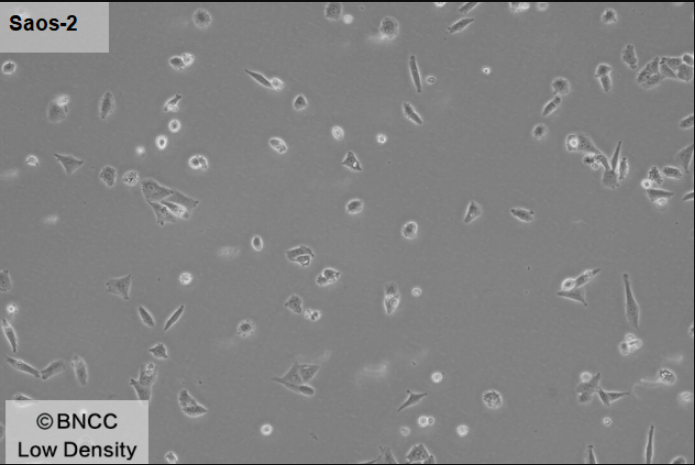
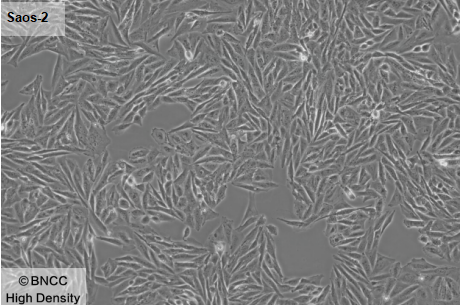
    Epithelial-like,Spindle-shaped (short),irregular edge
Essential Information References Certificate Related Products
Saos-2
Subculture procedure Resuscitation steps: ① Remove the frozen vial from liquid nitrogen or -80 ℃ refrigerator and place it in PE gloves. Quickly immerse it in a 37 ℃ water bath, shake the vial to accelerate dissolution, and dissolve it completely within 1 minute; ② Add the dissolved cell solution into a centrifuge tube containing 9mL of complete medium on a ultra-clean bench, centrifuge at 1000-1200rpm for 5 minutes, discard the supernatant, and resuspend the cells in 1-2mL of complete medium. ③ Add the cell suspension into a T25 flask containing 5-6mL of complete medium and place the flask in an incubator.
Cell passage: ① Remove the medium, rinse twice with PBS , and add 1-2mL pancreatin (0.25% Trypsin + 0.02% EDTA); ② Observe the digestion situation under the microscope. When the cell edge shrinks and the adherent is loose (a pasteur pipette can be used to suck up some pancreatin and gently blow somewhere in the cell layer, and the cell layer can be seen to detach with naked eyes, I .e. digestion is completed, otherwise digestion is continued), directly suck out pancreatin, add 5-6mL of complete medium, gently blow the cell layer off. ③ Divide the cell suspension into a fresh T25 flask at a ratio of 1:2, add appropriate complete culture medium, mix the cell suspension evenly, and culture it in the incubator.; ④ Pay attention to changes in the pH value of the culture medium and cell density, change the medium regularly (2-3 times a week), and repeat the passage operation or cryopreservation when the cell density reaches 80% -90%.
Growth conditions 37°C; 5% CO₂ + 95% air
Safety level 0
morphology Epithelial-like,Spindle-shaped (short),irregular edge
Sharing mode Public welfare sharing

1. cell name: Saos-2

2. No. & nbsp;:BNCC 338485

3. growth properties:  ■ adherence  □ suspension  □ semi-suspension and semi-adherence

4.  growth conditions:

culture medium 85% McCOY ' S 5A(SIGMA, article number M4892, add NaHCO3 2.2g/L)
serum 10%  FBS
temperature 37 ℃
atmosphere 5% CO2,95% AIR
frozen storage conditions culture medium 50%, serum 40%, DMSO 10%

5. composition:

composition specifications
frozen via 250 ul/1
handling procedure 1 copy

Attentions and handling procedures

1 upon receipt, please recover the cells immediately if dry ice is exhausted, and do not cryopreserve the cells again; If there is still dry ice, please immediately place the frozen vials into liquid nitrogen, and store the cells according to the specified conditions. Do not put the cells at high temperature.

2 Please recover the cells within 4 weeks after receipt, and check the cell viability. The compliant is not accepted if it is overdue reported.

3 It is not necessary to centrifuge the frozen cell, because the cryopreservation reagent proportion is optimized. After thawing, directly transfer 250ul of cell suspension into the culture vessel containing 8-10 ml of complete medium.

Recovery and subculture handling procedures of adherent cells ( under strict aseptic conditions )

1 Remove the medium in the original culture flask, rinse twice with PBS, and add 1~2 ml of 0.25% EDTA trypsin for digestion (usually in 1~2min).

2 Observe the digestion under the microscope. When the cell edge shrinks and adherent is loose, remove the trypsin, add 6~8ml complete medium, aspirate the cell layer off.

3 Transfer part of the cell suspension to a fresh culture vessel / flask, add appropriate complete medium, and culture it in the incubator.

4 Pay attention to the change of pH value of medium and cell density, renew the medium regularly, and repeat the subculture or cryopreservation when the cell density reaches 70%-80%.

Recovery and subculture handling procedures of suspension cells ( under strict aseptic conditions )

1 The suspension cells is normally handled by dividing the cell solution, subculture in separate flasks, that is, transfer half of the cell suspension to a fresh culture vessel, add appropriate complete medium and cultivate in incubator; It can also be divided and subcultured in several flasks according to cell density.

2 Pay attention to the change of pH value of medium and cell density, renew the medium regularly, and repeat the subculture or cryopreservation when the cell density reaches 70%-80%.

Handling procedures of semi-adherent and semi-suspended cells ( under strict aseptic conditions )

1 If there are many suspended cells with good refractive index, they can be collected by centrifugation and continue to be cultured.

2 If there are few suspended cells, it may not be collected. And subculture according to the handling procedures of adherent cells

3 If there are many suspended cells, collect them by centrifugation. The adherent cells in the flask are operated according to the handling instructions of adherent cell for digestion, termination of digestion, aspiration. Suspend them with the previously collected suspension cells and dispense into separate culture vessels.

Download certificate
Please set your password: